

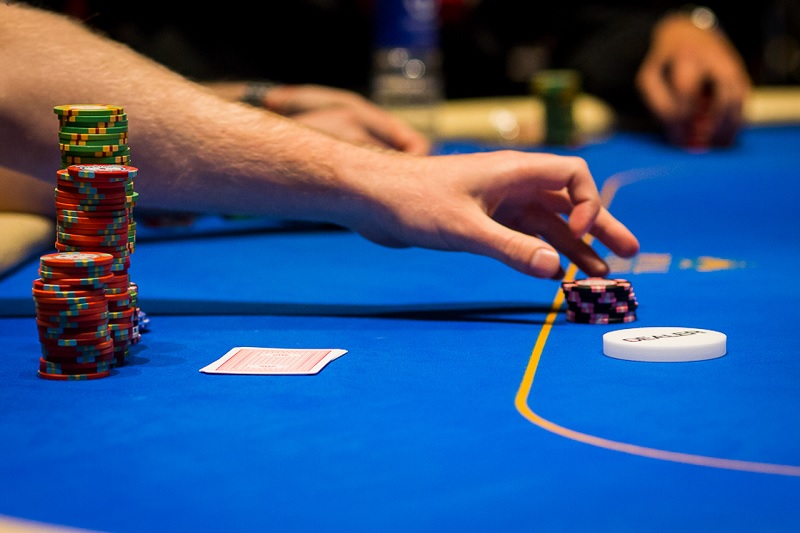
To the uninitiated observer, a poker table looks like a chaotic battleground of luck where the highest cards inevitably sweep the board. This illusion of chance is precisely what keeps the amateur coming back, funding the professionals who understand the underlying truth. Competitive poker is not a game of luck wrapped in betting; it is an intricate exercise in mathematics, behavioral psychology, and aggressive risk management. The cards you are dealt represent only a fraction of the overall picture. The true essence of the game lies in how effectively a player navigates the intersection of mathematical probability and strategic execution. Every bet, raise, fold, and check is a calculated decision designed to exploit the mathematical mistakes of opponents while minimizing one’s own exposure to risk.
The Mathematical Foundation: Probability as the Baseline
Before a player can successfully execute a complex bluff or read a physical tell, they must completely internalize the mathematics governing a standard deck of fifty-two cards. Probability acts as the invisible architecture of the game. It dictates the fundamental worth of a starting hand and governs the exact likelihood of improving that hand as community cards are revealed. Professional players do not rely on a nebulous feeling of being lucky; they rely on concrete numbers and expected outcomes.
Expected Value and Pot Odds
The cornerstone of poker mathematics is the concept of Expected Value (EV). Every decision made at the table carries a mathematical expectation of profit or loss over an infinite timeline. A positive EV decision means that, on average, the specific play will yield a profit, while a negative EV decision will slowly but surely drain a bankroll.
To calculate this in real-time, players constantly analyze pot odds, which is the ratio of the current size of the pot to the cost of a contemplated call. If the pot holds one hundred dollars and a player must call twenty dollars to stay in the hand, they are getting five-to-one on their money. If the probability of drawing the winning card is better than five-to-one, making the call is a mathematically sound, positive EV decision. Over a sample size of ten thousand hands, making that exact call will guarantee a profit, regardless of whether the specific card hits in that singular, isolated moment.
Beyond the Math: The Strategic Imperative of Hand Ranges
If poker were purely about calculating static probabilities, supercomputers would have solved it decades ago, and human interaction would be entirely irrelevant. The complexity of the game arises from the thick fog of imperfect information. Because opponents’ cards are hidden, raw probability cannot be applied to static certainties. Instead, deep strategy steps in to fill the gaps in information.
Elite players do not try to guess the exact two cards their opponent is holding. That is a hallmark of amateur, emotionally driven play. Instead, professionals assign their opponents a hand range, which is the complete spectrum of logical card combinations a player could hold based on their specific actions throughout the betting rounds.
If an opponent raises aggressively from an early position, their range is incredibly narrow, heavily weighted toward premium pocket pairs and strong Broadway cards. As the hand progresses, every check, bet size, and hesitation acts as a data filter, allowing a skilled strategist to systematically eliminate combinations from that range. The probability calculations are then applied not to a single guessed hand, but to the weighted average of this entire strategic range.
The Power of Positional Strategy
Understanding the math is useless if a player lacks the strategic framework to apply it, and no strategic concept is more critical than your physical position at the table. In popular variants like Texas Hold’em and Pot-Limit Omaha, the order of action remains static after the flop is dealt. The players forced to act first are at a massive disadvantage, operating completely in the dark regarding the intentions of the rest of the table.
Playing in position—meaning you act last or near the end of the betting round—grants a player the ultimate strategic luxury: information. By observing the checks, bets, and specific chip sizing of the opponents acting before them, a player in position can accurately refine their opponents’ hand ranges before committing a single chip of their own. This informational asymmetry is so powerful that a highly skilled player holding mathematically inferior cards in late position will consistently outperform a novice holding superior cards in early position. Position allows players to dictate the final size of the pot, take free cards when they are drawing to a better hand, and apply maximum pressure the moment weakness is detected.
Bluffing: A Calculated Manipulation of Odds
Hollywood often portrays the bluff as a dramatic, ego-driven staredown where one player simply out-wills the other. In the reality of competitive poker, a bluff is a precise mathematical construct designed to manipulate an opponent’s pot odds and leverage fold equity. Fold equity is the additional financial value a player gains in a hand based on the mathematical probability that an aggressive action will force an opponent to surrender their cards.
When a professional bluffs, they are not acting recklessly. They are carefully evaluating the texture of the community cards, the opponent’s perceived range, and the specific bet sizing required to make calling mathematically incorrect for the opposing player. Furthermore, high-level strategy dictates that bluffs must be perfectly balanced. If a player only bets large amounts with unbeatable hands, observant opponents will simply fold every time, rendering those premium hands unprofitable. By injecting calculated bluffs into their betting range, professionals disguise their strong hands, forcing opponents into agonizing decisions where the math is intentionally blurred. The bluff is effectively the strategic tax players charge their opponents for trying to realize their own equity.
Game Theory Optimal versus Exploitative Play
The modern era of competitive poker is heavily defined by the advent of complex software solvers. These powerful programs have mapped out Game Theory Optimal (GTO) strategies. GTO is a defensive, mathematically unexploitable style of play. If a player executes a perfect GTO strategy, the absolute best an opponent can mathematically achieve over the long run is breaking even. Solvers have taught a new generation of players the exact frequencies with which they should bet, check, raise, and fold every conceivable combination of cards in every possible situation.
However, executing pure GTO is impossible for the human brain, and often, it is not actually the most profitable approach in a live setting. This is where human strategic intuition overrides pure mathematical equilibrium. The most successful players in the world use GTO as their baseline compass but actively pivot toward exploitative play.
If an opponent is calling bets too frequently, a strategist abandons GTO balancing and simply bets their strong hands relentlessly for maximum value, completely removing bluffs from their range. If an opponent is folding too easily under pressure, the strategist heavily over-bluffs. The true mastery of the game lies in recognizing the precise moment to deviate from the safety of mathematical equilibrium in order to exploit the psychological and strategic leaks of the flawed humans sitting across the table.
Navigating the Brutal Reality of Variance
Perhaps the most difficult aspect of competitive poker is enduring the psychological toll of variance. Variance is the statistical deviation from expected value over a short sample size. A player can make mathematically flawless decisions for an entire week, get their money into the middle as an overwhelming statistical favorite, and still lose substantial amounts of cash because the low-probability outcomes happened to materialize in rapid succession. This unavoidable phenomenon is known as a bad beat.
Amateurs allow variance to dictate their emotional state, often abandoning their strategic foundation when the cards run cold. This emotional unraveling, known as going on tilt, is the primary reason most players fail to sustain a career. Professionals, however, view variance as a necessary business expense. They understand that the very luck allowing a bad player to win a single tournament or a massive pot is exactly what keeps that bad player coming back to the cash games day after day. Proper bankroll management and ironclad emotional regulation are the strategic shields professionals use to survive the short-term cruelty of probability.
Mastering competitive poker requires a brain fundamentally divided. One half must operate like a cold, calculating machine, rapidly computing pot odds, expected value, and combinatorial frequencies. The other half must be deeply human, capable of psychological warfare, strategic manipulation, and empathetic reading of the fears and tendencies of others. Probability provides the raw, undeniable data, but strategy dictates exactly how that data is weaponized. For those willing to study the math and embrace the relentless mental grind, poker ceases to be a gamble. It becomes a beautiful, infinitely complex puzzle of risk and reward, where the most disciplined and observant mind ultimately claims the chips.

Comments are closed.